Exclusive to kayfabe-records.com
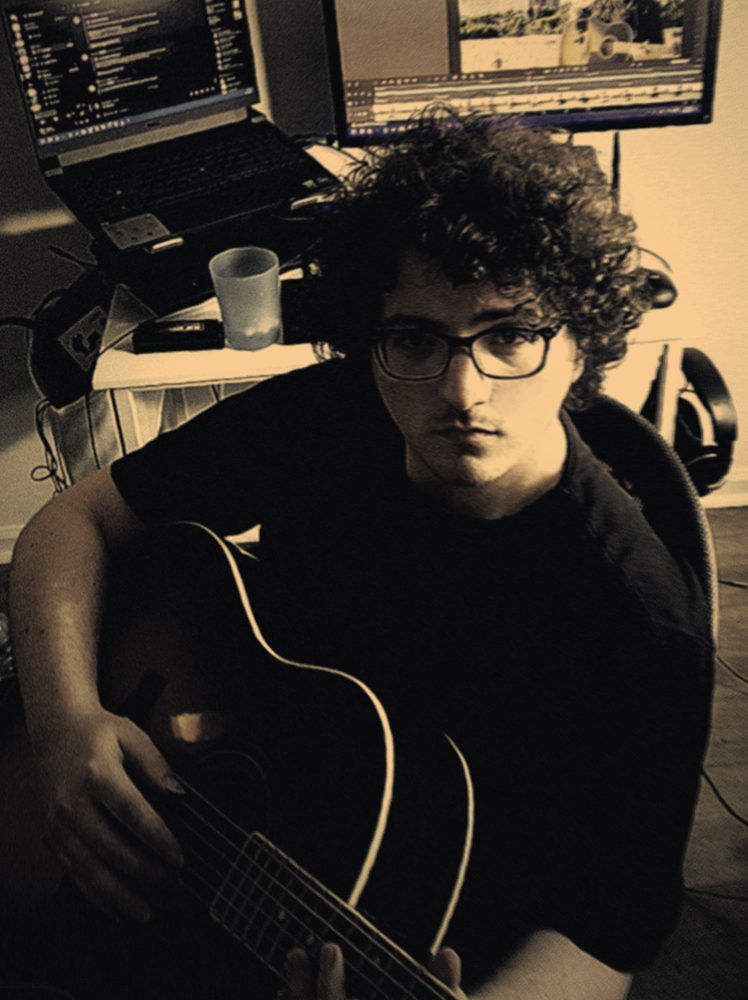
In advance of the release of Dan Ascher, Kayfabe Records staff writer Frank Angle sits down with the artist, CC Ascher, to discuss his debut album and first official release with the Kayfabe family.
FA: You’ve made a record that sounds, on first contact, like it could have been recorded sixty years ago.
CC: I don’t know if I’d agree with that, but sure.
How did you go about doing that?
It was admittedly a longer process than I’d like to admit, particularly for an album of single-takes. But me and my producer had to make some decisions with the sound, particularly as we were trying to evoke that Folk Revival type of sound. So that entails some tradeoffs between antiquated techniques and emulations, and more modern-facing choices. But I like to think that we took the right paths, even if we may be the only ones listening close enough to notice.
Should that be heard as nostalgia?
I mean, it’s not like I was alive back then. There’s nothing for me to be nostalgic about.
Maybe it’s more rosy retrospection.
Not even. I know that it’s a trend amongst people of my generation to romanticize the past or whatever. But the albums you’re probably thinking of don’t sound old to me. Music used to age and be replaced but things have changed. Now we have spotify. To me, Louis Armstrong sounds just as old as Beethoven and, I don’t know, The Strokes or Greta Van Fleet. Just because something happened long ago doesn’t make it any less present.
But Louis Armstrong isn’t alive.
And yet I interact with him the same way I do Sabrina Carpenter.
Fair enough.
“Talkin’ America” is basically you showing up looking for a scene that’s been dead for sixty years and finding a twenty-dollar cocktail where the Gaslight used to be. Did you actually go looking for it in person, or did you already know it wouldn’t be there and write the disappointment in advance?
I already knew that the scene was dead, so the disappointment (if you can call it that) never had anything to do with anything. I just went there because I had to see the places with my own eyes. Thought that maybe I’d find or catch something there. There’s no Gaslight anymore, but I did get to play some open mics around the Village area. I was visiting New York and crashing on some friend’s couch somewhere outside the city, this must have been sometime in twenty-twenty-four. I managed to play a set with a borrowed guitar down at some KGB bar. The guy that played before me introduced me to Geese’s music.
So you weren’t disappointed?
I don’t know, disappointment with these things is pointless because its inevitable. I can’t be disappointed with the past for being in the past. That would be silly.
But why aim for the sound of the Folk Revival? Do you feel some sort of connection to it?
I guess what I was actually aiming for was the studio sound of that era, not the revival itself. The idea was to get to a sound that wasn’t indicative of laborious studio engineering or hyperreal soundscaping. At the time, producers were getting working musicians and recording their performances as they were. These recordings weren’t meant to be masterpieces of sound design, they were meant to be recordings, photographs in sound. With just enough engineering to get at a precision of sound in a controlled space. In that sense, I guess this album is in the middle between that sound and the intention behind a field recording.
Like Lomax?
Yes. The artists at the time of the revival were mostly performing in basket houses with the occasional larger venue, and both their performance and recording styles reflected that. The Lomax field recordings were no different in that they captured sounds in their time and place. In my case, even though I’ve done my fair share of bar and open mic performances over the years, I now spend most of my time in personal indoor spaces like most people do. People work at home, go to the movies at home, listen to music at home. So that makes my bedroom the field to be recorded.
I’ve heard a lot of people say (by way of prediction) that, given the rise of generative AI, audiences will begin valuing the rawness of real performance, of things that can’t be replicated by AI so as to ensure that they are interacting with a real human. Given the nature of your material, folk music, and the way you are approaching this record, is it fair to say that this is something that you are trying to lean into with this album, or with your musical project as a whole?
In a way, I’d say so. But I wouldn’t attribute that to wanting to be on the cutting edge of what people may want. I do lean into reality by, for example, choosing takes that aren’t perfect. My mistakes reveal more about the music than any ultra-polished and practiced recording would. But the truth is that this is an experiment in music. Most people don’t want the ugly or the human. People only want the human inasmuch as it can give them a platform to posture against an other side. Very few people have the patience it takes (or the desire, or the will) to cut through the thickness of the real to find whatever may be on the other side. Everyone wants their music pre-chewed. And no amount of AI panic will get in the way of our need for convenience, smoothness, painlessnes, and comfort. I may be wrong though.
What about you?
Evidently I like the chewing. Sometimes the effort is what makes the pleasure valuable.
As far as I know, you have decided to host this album exclusively here on the Kayfabe Records platform, with some extra visual content on YouTube. Any reason behind deciding against uploading to other major platforms?
If I’m not going to be making any money off my music anyways, I’d rather it be on my own terms, and the Kayfabe platform gives me enough freedom to present my music however I want. Of course, that could change, I may end up surrendering to the platforms at some point. But, for the time being, I’m good here.
“At least while I sing them, and while they are heard, we momentarily bring back these songs to the land of the living.”
Speaking of, what kind of music were you listening to during the making of this album?
Well, a lot of Blind Willie McTell, Jimmy Reed, Lonnie Johnson, Mississippi John Hurt, Little Walter, Memphis Jug Band. Anything that makes its way to GemsOnVHS is fine by me. Also, a little bit of Murphy Campbell’s music, Muireann Bradley, Nat Myers, and a whole lot of Cat Clyde.
There’s a lot of death on this record for someone very young. Are you comfortable borrowing the voices of dead men?
I wanted to dedicate my first album to the people that went before me, acknowledge some of my influences. In a sense, I’m doing what I feel like I have to do before I get to be going to wherever it is I get to be going to. And I don’t know about borrowing their voices, but what I do know is that, at least while I sing them, and while they are heard, we momentarily bring back these songs to the land of the living. When they’re part of my repertoire, they stop being buried behind the silence of an archive or the hum of some datacenter somewhere. The lyrics are in my mind, and the movements are in the muscle memory of my hands. Some people say we stand on the shoulders of giants, but I’d say I am made of them. Or at least the best parts of me are. I’m not borrowing anything.
Can we expect more music from you sometime soon? Perhaps original material?
Yes you can, very soon.
If you want listeners to take just one thing from this record, what would it be?
That it’s my first plea.
So, you’re not Neil Young and you’re not Phil Ochs. Who are you then?
CC Ascher.
Dan Ascher will soon be available for streaming here on the Kayfabe Records website, as well as in a full-album visualizer on YouTube.